The Role of AR and VR in Education: Will Schools Become Fully Virtual?
Students today are learning faster and differently than previous generations. Advances in digital technologies—particularly Augmented Reality (AR) and Virtual Reality (VR)—are transforming multiple industries, and education is no exception. The COVID-19 pandemic further accelerated digital adoption in classrooms, prompting an important question: will schools eventually become fully virtual?
This article examines the role of AR and VR in education, their benefits, real-world applications, limitations, and whether they will replace physical classrooms or simply enhance traditional learning environments.
Understanding AR and VR in Education
Augmented Reality (AR)
Augmented Reality overlays digital information onto the real world in real time. In educational settings, AR allows students to interact with 3D models, scan textbooks for additional content, and visualize complex or abstract concepts using smartphones, tablets, or AR-enabled devices.
Virtual Reality (VR)
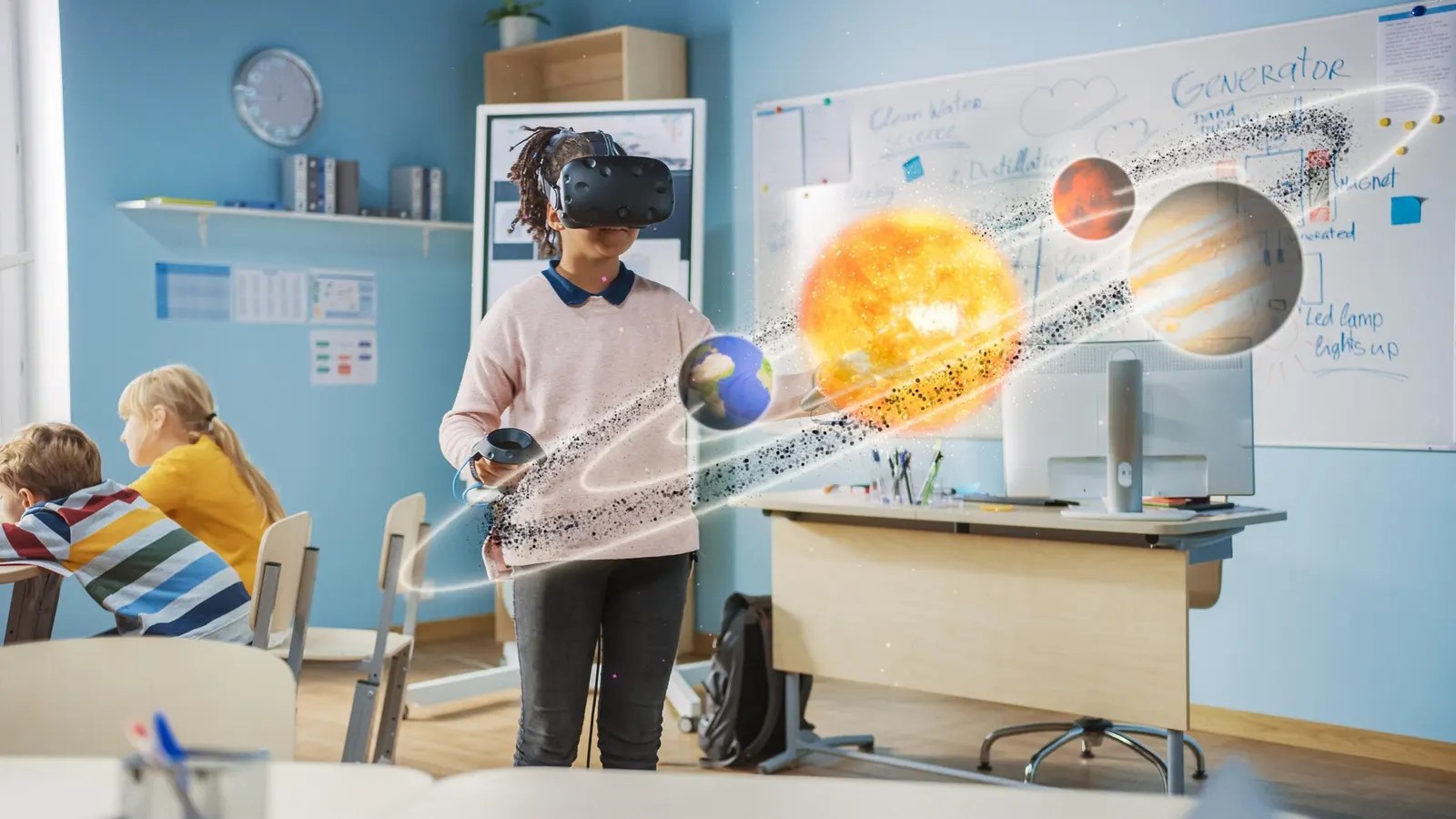
Virtual Reality creates fully immersive digital environments where students can explore virtual laboratories, participate in simulated experiments, or experience historical events firsthand. VR typically requires head-mounted displays and supporting software to deliver immersive learning experiences.
Benefits of AR and VR in Education
Enhanced Engagement and Knowledge Retention
Traditional learning often relies on passive instruction. AR and VR introduce interactive, hands-on experiences that improve comprehension and long-term retention. Immersive learning has been shown to increase student focus and understanding.
Real-World Learning Without Physical Limitations
AR and VR enable experiential learning beyond classroom boundaries. Medical students can practice surgical procedures, history students can explore ancient civilizations, and engineering students can test designs in virtual environments before real-world implementation.
Personalized Learning and Accessibility
AR and VR support diverse learning styles and accessibility needs. Students with learning disabilities benefit from visual and interactive tools, while language learners gain from real-time translation and immersive language environments.
Cost Efficiency and Scalability
Virtual laboratories can reduce dependence on expensive physical equipment. AR and VR also allow students in remote or underserved regions to access high-quality educational experiences without relocation.
Encouraging Creativity and Innovation
Immersive technologies enable students to design, simulate, and experiment in virtual spaces, fostering creativity, critical thinking, and problem-solving skills.
Real-World Applications of AR and VR in Schools
Medical and Healthcare Education – VR-based surgery simulations and anatomy training
STEM Education – Interactive physics, chemistry, and engineering simulations
History and Geography – Virtual field trips to historical landmarks and global locations
Language Learning – Immersive environments that support pronunciation and conversational skills
Special Education – Social skill development and behavioral training for students with autism
Challenges and Limitations of AR and VR in Education
Cost and Infrastructure Requirements
High-quality AR and VR solutions require investment in hardware, software, and technical infrastructure, which may be beyond the reach of many educational institutions.
Internet Connectivity and Hardware Limitations
Reliable high-speed internet and compatible devices are essential for smooth AR and VR experiences. Limited access creates a digital divide between institutions and regions.
Health and Psychological Considerations
Extended use of VR may cause motion sickness, eye strain, or fatigue. Excessive reliance on virtual environments may also impact real-world social development.
Teacher Training and Adoption Barriers
Effective use of AR and VR requires educators to be trained in both technology and instructional design. Without proper training, implementation can be ineffective or underutilized.
Will Schools Become Fully Virtual?
Growth of Virtual and Metaverse-Based Learning
Technology companies are developing virtual campuses where students interact in shared digital environments. These models may expand remote education options, particularly for higher education and professional training.
AI-Powered Personalized Education
The integration of AI with AR and VR will enable adaptive learning paths tailored to individual student progress, pace, and preferences.
Blended or “Phygital” Education Models
Rather than replacing physical schools, AR and VR are more likely to enhance traditional classrooms. Blended learning models combine in-person instruction with immersive digital experiences.
Global Education Without Borders
AR and VR enable cross-border learning, allowing students to access global institutions and resources regardless of location.
Augmented Reality and Virtual Reality are set to significantly transform education, but they are unlikely to fully replace physical schools. Instead, these technologies will enhance learning by making it more interactive, personalized, and inclusive.
Institutions that adopt AR and VR strategically will be better positioned to prepare students for a technology-driven future. The real question is not whether AR and VR will shape education—but how quickly schools will integrate these tools into meaningful learning experiences.