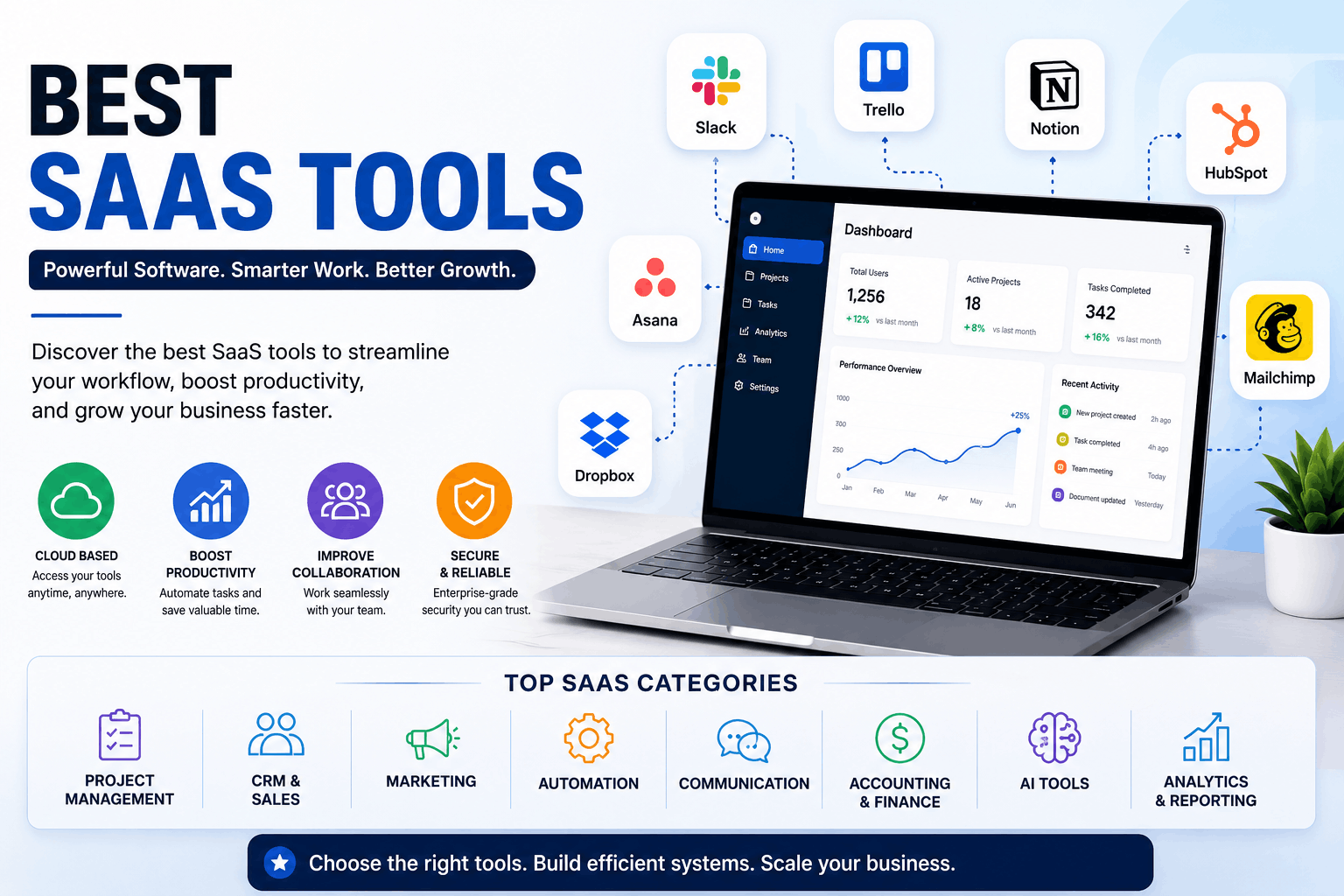
Essential Software Solutions for Modern Businesses
Running a business today is no longer just about working harder—it is about building smarter systems.
From project management and customer communication to marketing and automation, businesses now rely heavily on SaaS tools to improve efficiency and scale operations. In fact, many startups and online businesses operate entirely using cloud-based software without needing expensive infrastructure.
But here’s the challenge:
There are thousands of SaaS tools available.
Most businesses end up:
- using too many tools
- paying for unnecessary features
- creating disconnected workflows
The goal is not to collect software.
The goal is to build a simple, connected, and productive system.
This guide explores the best SaaS tools across different categories, how they help businesses grow, and what you should actually focus on before choosing one.
What Are SaaS Tools?
SaaS stands for Software as a Service.
Instead of installing software on your computer, SaaS tools run online through the cloud. Users can access them from anywhere using a browser or mobile app.
Common Examples
- project management platforms | email marketing tools | CRM systems | automation software | collaboration tools
⚡ Recommended Products


The SaaS Revolution: Understanding and Leveraging the Power of Software as a Service
The SaaS Revolution: Understanding and Leveraging the Power of Software as a Service
View Product →
Hacking SaaS: An Insider's Guide to Managing Software Business Success
Hacking SaaS: An Insider's Guide to Managing Software Business Success
View Product →Why SaaS Tools Are Dominating Modern Business
Lower Costs
Businesses avoid expensive hardware and maintenance.
Remote Accessibility
Teams can work from anywhere.
Faster Scalability
Businesses can upgrade plans as they grow.
Continuous Updates
Most SaaS tools update automatically with new features and security improvements.
Categories of SaaS Tools Every Business Should Know
Project Management Tools
Why They Matter
Without proper task management:
- deadlines get missed
- communication breaks down
- productivity drops
What These Tools Help With
- task assignment
- workflow tracking
- collaboration
- deadline management
Best For
- startups
- remote teams
- freelancers
CRM and Sales Tools
Why They Matter
Customer management becomes difficult as businesses grow.
CRM tools help organize:
- leads
- follow-ups
- customer communication
- sales pipelines
Insight
Businesses often lose leads not because of poor marketing, but because follow-up systems are weak.
Marketing SaaS Tools
What They Help With
- email campaigns
- social media scheduling
- analytics
- SEO optimization
Important Insight
The best marketing tools are not always the most advanced.
They are the ones your team can actually use consistently.
Workflow Automation Tools
Why They Matter
Manual tasks consume time and reduce scalability.
Automation tools help:
- connect apps
- automate repetitive tasks
- reduce manual errors
Example
- form submission
- → email trigger
- → CRM update
- → follow-up reminder
All automated.
AI-Powered SaaS Tools
Growing Trend
AI is becoming part of modern SaaS platforms.
Common AI Features
- content generation
- predictive analytics
- customer support automation
- smart recommendations
Real Insight
AI tools improve productivity, but businesses still need human strategy and decision-making.
Communication and Collaboration Tools
Why They Matter
Strong communication improves execution.
These tools support:
- team discussions
- video meetings
- file sharing
- real-time collaboration
Financial and Accounting SaaS Tools
What They Help With
- invoicing
- expense tracking
- budgeting
- financial reporting
Why Important
Cash flow visibility is critical for business survival.
How to Choose the Right SaaS Tool
Start With the Problem, Not the Tool
Most businesses choose tools because they are trending.
Instead, ask:
- What problem am I solving?
- Which process needs improvement?
Avoid Tool Overload
Using too many SaaS tools creates:
- confusion
- higher costs
- disconnected workflows
Simple systems usually perform better.
Check Integration Capabilities
Your tools should work together.
Disconnected systems create operational problems.
Test Before Committing
Use:
- free trials
- starter plans
before scaling.
Real Business Example
Small Startup Workflow
A small startup uses:
- project management software for tasks
- CRM for lead tracking
- automation tools for follow-ups
- marketing software for campaigns
Result
- better organization
- improved customer response
- scalable operations
Common Mistakes Businesses Make
- Paying for Features They Never Use: Many businesses buy advanced plans unnecessarily.
- Ignoring Team Adoption: A tool is useless if your team does not use it consistently.
- Switching Tools Too Frequently: Constant switching creates workflow disruption.
- Choosing Complexity Over Simplicity: Complicated systems reduce productivity.
Future of SaaS Tools
The SaaS industry is evolving rapidly.
Key trends include:
- AI-driven automation
- low-code and no-code platforms
- deeper integrations
- personalized workflows
- smarter analytics
Businesses that adapt early will gain operational advantages.
Final Thoughts
SaaS tools are no longer optional for modern businesses.
The right combination of tools can:
- improve efficiency
- reduce operational stress
- increase productivity
- support business growth
But the real advantage does not come from using more tools. It comes from building systems that work smoothly together. That is what separates productive businesses from chaotic ones.


