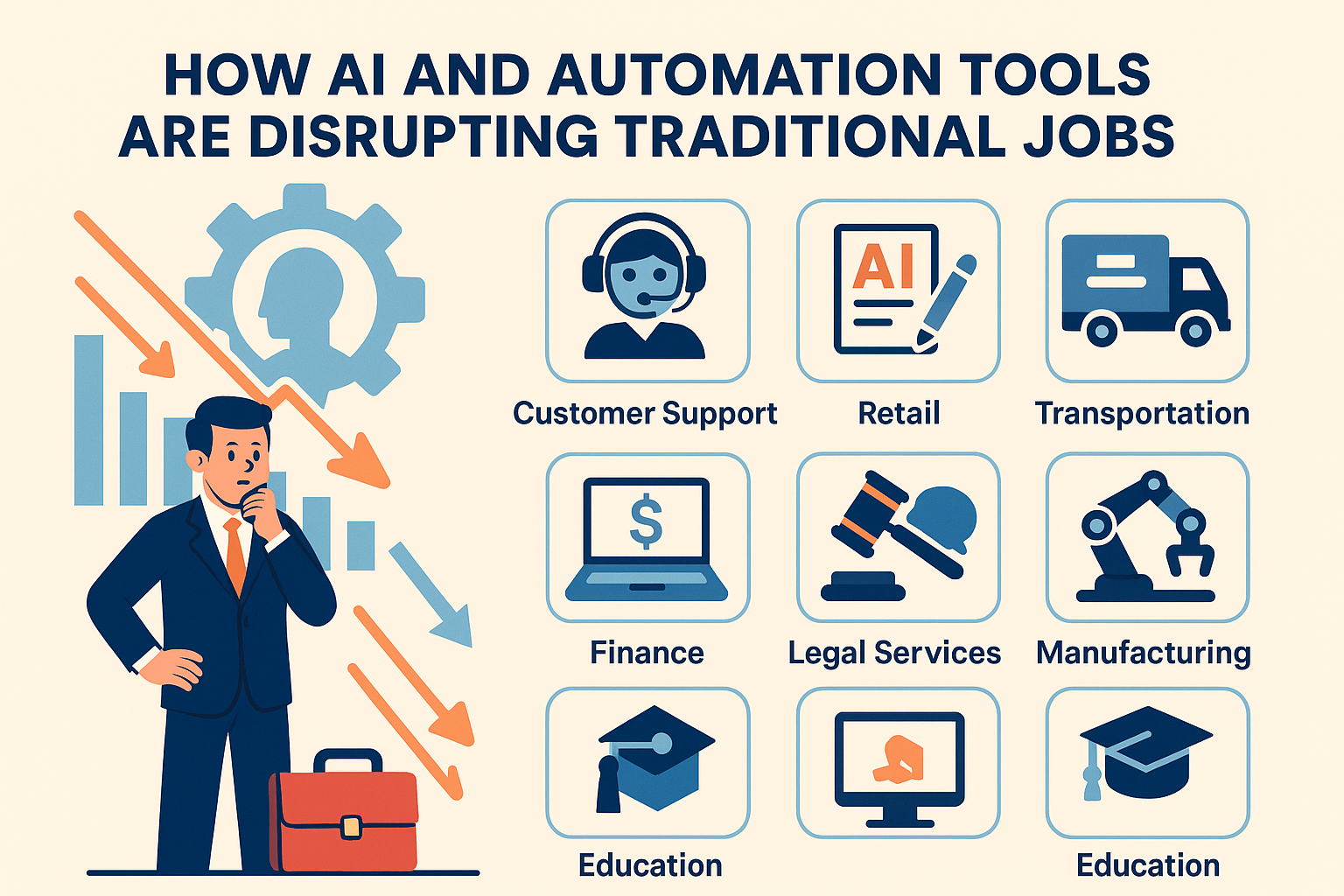
Artificial Intelligence (AI) and automation tools have rapidly transformed the business landscape. From streamlining operations to replacing repetitive tasks, these technologies are not just enhancing productivity—they are also reshaping the job market in ways many didn’t anticipate. As companies strive for efficiency, several traditional jobs are being affected, reinvented, or even replaced.
We’ll explore the industries most impacted by AI and automation, how specific job roles are changing, and what the future looks like for workers in those sectors.
1. Customer Support & Call Centers
Impact: High
AI Tools Involved: Chatbots, Natural Language Processing (NLP), Voice Assistants
Companies now use AI chatbots and virtual agents to handle 60-80% of common customer inquiries. This has led to a decline in the demand for entry-level call center agents, especially in outsourcing hubs.
Example: A single AI chatbot can handle the workload of 10 support agents—24/7, without breaks.
2. Retail & E-Commerce
Impact: Medium to High
AI Tools Involved: AI Inventory Systems, Smart Recommendations, Self-Checkout Machines
AI is being used in pricing optimization, product recommendations, and customer behavior tracking. In physical stores, cashier-less checkouts and automated stock-taking robots are reducing the need for traditional retail staff.
Example: Amazon Go stores allow customers to shop without interacting with a human cashier.
3. Content Creation & Marketing
Impact: Medium
AI Tools Involved: ChatGPT, Jasper, Copy.ai, Grammarly, Canva AI
AI is now helping generate blog posts, social media content, product descriptions, and even email campaigns. While it hasn’t replaced creative professionals completely, it has reduced the demand for entry-level content writers and graphic designers.
Example: Many businesses now use AI tools to generate first drafts or ad copy instantly, requiring fewer human edits.
4. Transportation & Logistics
Impact: High (and increasing)
AI Tools Involved: Route Optimization, Autonomous Vehicles, Warehouse Robotics
Logistics companies are using AI for real-time tracking, optimized delivery routes, and robotic warehousing. Driverless delivery vehicles and drones are also being tested and deployed in some regions.
Example: UPS and FedEx use AI to plan optimal delivery routes, reducing the need for extra drivers and logistics staff.
5. Finance & Accounting
Impact: High
AI Tools Involved: Robotic Process Automation (RPA), Predictive Analytics, AI Auditing Tools
Basic bookkeeping, invoice processing, and fraud detection are now largely handled by AI. Entry-level accounting and data entry jobs are declining as a result.
Example: Tools like QuickBooks and Xero have built-in AI features that automate 70% of manual accounting tasks.
6. Legal Services
Impact: Medium
AI Tools Involved: Legal Research Tools, Contract Review Bots, Predictive Judgement AI
Legal firms use AI to review contracts, analyze case histories, and even predict legal outcomes. While senior lawyers are still crucial, paralegal and research assistant roles are being reduced.
Example: AI platforms can review 1,000+ legal documents in minutes—something that would take junior lawyers weeks.
7. Manufacturing & Industrial Work
Impact: Very High
AI Tools Involved: Robotics, AI-driven Assembly Lines, Predictive Maintenance
Factories have been early adopters of automation. Robots powered by AI handle welding, painting, assembly, and even quality checks—displacing many low-skill manual jobs.
Example: Tesla’s factories use hundreds of AI-powered robots, drastically reducing the human workforce on the floor.
8. Education & Training
Impact: Medium
AI Tools Involved: Personalized Learning Systems, Virtual Tutors, Grading Bots
Online learning platforms are using AI to personalize curriculum and automate grading. This reduces the need for repetitive administrative work by teachers and tutors.
Example: AI-powered apps like Khan Academy and Duolingo personalize learning paths based on user behavior.


